
Trump’s visa fee hike and India’s talent dilemma

Thanks to the sheer scale of the Indian Higher Education System, there was a steady flow of doctors, engineers, and technologists, who were academically sound and prepared to work in challenging environments. Indian immigrants’ familiarity with English, their ability to adjust to institutional hierarchies, and their persistence in navigating competitive systems meant that they could integrate quickly into American structures. Gradually, with these traits they moved to organisational leadership.
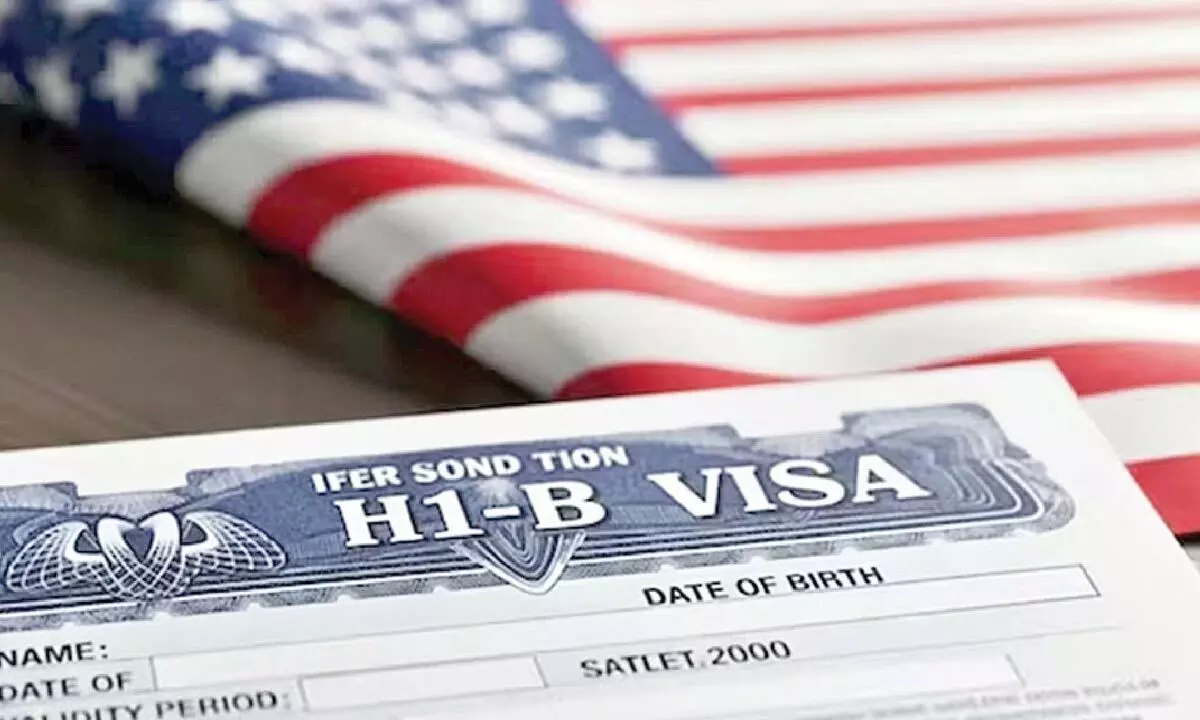
USPresident Donald Trump’s decision sharply hiking the ‘H-1B non-immigrant visa fee’ from September 21, triggered panic among immigrant families, especially in abroad at the time, until White House clarified the next day that the revised fee does not apply to current H-1B visa holders or renewals. The measure has hit Indian tech professionals the hardest. The Union Government expressing serious concern stated that the consequences may lead to disruption for families.
Telangana Chief Minister A Revanth Reddy describing the move as totally unacceptable urged the Prime Minister Narendra Modi to address this on a war-footing, while the latter reaffirmed India’s commitment to the spirit of Vishwa Bandhu (Universal Brotherhood). He, however, cautioned that over-dependence on other nations remained a challenge. Emphasizing the importance of self-reliance, he said, whether it is ‘Chips or Ships’ they must be manufactured in India to realize the vision of Atmanirbhar Bharat.
Correspondingly, a recent Parliamentary Committee had underlined the urgency of expanding higher education capacity, strengthening research infrastructure, adopting long-term approach to retain and recover human capital, warning that unchecked outflow of skilled professionals would perpetuate ‘Brain Drain’. Taken together, these three aspects- Trump’s H-1B non-immigrant visa fee hike carries advantages and disadvantages for both United States and India.
In any nation, the decisions of a President or Prime Minister must be understood against the backdrop of constantly shifting political, social, and economic landscapes. Public preferences, emerging priorities, pressures from domestic and international players influence policies. The immediate benefits or hardships resulting from such decisions, including that of Trump are relative, varying across communities and stakeholders.
Criticism, therefore, instead of blind, should be measured against this framework, recognising that the ultimate success, failure, or sustainability of a particular measure can only be assessed in light of the complex and evolving circumstances in which it was made.
The history of immigration or emigration from nation to nation, to suit changing needs has multiple dimensions, especially in the context of US. Despite USA’s dislike to depend on foreign professionals, the compulsions gave birth to the Immigration and Nationality Act of 1952, or the McCarran-Walter Act, which laid the early foundation to permit limited entry of foreign specialists. In the 1960s when USA faced an acute shortage of physicians in tune with medical needs which rose sharply, the doors opened wider.
Hospitals and teaching institutions looked overseas, and gradually foreign medical graduates, including from India and South Asia, were being recruited in large numbers, typically under J-1 exchange visas. Subsequently, with Silicon Valley’s innovation economy and a surge in demand for engineers and computing professionals, the domestic system could not quickly supply. Indian Institutes of Technology (IITs) and a growing base of English-educated engineers became natural reservoirs for their readiness to work within new systems.
The legislative crystallization of this process came with the 1990 Immigration Act formally creating the H-1B visa facility, to expand access to foreign professionals. Their first foothold was entirely job-related, residency programs for medical graduates, and later, technology jobs under H-1B. Once inside, they did not confine to their professions and gradually began to navigate organizational cultures, manage teams, and learning to negotiate within the American corporate or institutional ethos. This progression carried them from technical expertise to strategic leadership, including reaching the CEO levels.
Most doctors, engineers, and IT professionals came through structured legal channels, residency programs, H-1B or similar visas and tied directly to their jobs. Despite their journey was rarely smooth, they transitioned step-by-step into ‘Permanent Residency (Green card) and Citizenship.’ This was less about diversion and more about continuity, since both health care and technology sectors faced chronic shortages. By the early 21 century, Indian professionals, physicians and specialists in software, had come to dominate.
Over time, second-third-generation immigrants, and even some first-generation professionals, branched into academia, entrepreneurship, business ownership, community leadership, and politics. While this was a natural extension of integration into American Society, such visibility of foreign-born professionals, eventually led to unease about job competition among native citizens. However, employers continued to depend on immigrant talent, especially from India. Critiques of H-1B usage often came from labor unions, domestic professional associations, and political groups. This crystallised sharply in the Trump years with visa restrictions. Hence it is not an overnight decision.
In fact, foreign professionals, especially Indians, filled indispensable roles and contributed positively to innovation, health care access, and economic growth. Their movement beyond the original narrow work role was not by subversion but by natural assimilation into the wider opportunities of American civic and economic life. This was sometimes uncomfortable for sections of native citizens, but structurally it became part of the US immigrant integration story rather than an unwanted intrusion. Their entry was driven by shortages in specialized fields, yet once inside the system, they often stood out. Overtime this not only secured them continuity of employment but also positioned them for gradual career advancement.
This combination of intellectual preparation, hard work, adaptability, and readiness to maneuver within the existing systems created a visible track record of credibility. Such a rise amounted to outshining native citizens, the interplay between global talent mobility, opportunity structures in the US, and the distinct capacities of individuals to stretch beyond their initial roles.
Thanks to the sheer scale of the Indian Higher Education System, there was a steady flow of doctors, engineers, and technologists, who were academically sound and prepared to work in challenging environments. Indian immigrants’ familiarity with English, their ability to adjust to institutional hierarchies, and their persistence in navigating competitive systems meant that they could integrate quickly into American structures.
Gradually, with these traits they moved to organisational leadership, showing how migration pathways could translate into positions of influence including in governance, well beyond the original spheres of entry.
Alongside professional contributions, immigrants’ journey, especially of Indian origin, also carried other dimensions, such as, exhibiting enthusiastic public celebrations during festivals, marriage processions, cinema releases, establishing huge Hindu temples, statutes, and community events, sometimes creating irritants being perceived as excessive occasionally.
Furthermore, Indians unknowingly played into unbalancing local ecosystems, such as, importing pickles, seeds, and foods, later cultivating vegetables including gourds and pumpkins. What seemed natural to them occasionally clashed with American concerns of regulation and environment. These patterns of ecological imports and festive visibility reflected the ongoing negotiation between cultural continuity, ecological adaptation, and public order in the host country, the USA.
The ‘Trumpeted visa hurdles’ primarily reflect the economic and political interests of US citizens, through challenges. However, they have nothing to do with the historical patterns of racial or ethnic discrimination of earlier decades. Trump’s policy, even after it withstands Judicial and Legislature scrutiny, is confined to the US and is unlikely to effect on Indian or other countries’ professionals seeking opportunities in European Countries, including UK, where migration pathways operate independent of American measures.
Policy debates, whether in Washington or New Delhi, have at different times emphasized opportunity, loss, or protection. Yet the long arc shows that the migration of professionals, especially Indians, was less about displacement and more about an evolving partnership shaped by demand, supply, and the resilience of individuals.
In the broader perspective, decisions like the Trump visa policy, combined with the US role as the largest destination for Indian and Asian professionals, indirectly influence cultural continuity, illustrating how traditions evolve in a continuum, from localization to globalisation and, at times, back again.
India, meanwhile, watched this with mixed emotions, pride in global achievement, but also a reprieve from ‘Brain Drain’ and the anticipation of retaining Indian talent for national development.
Printed & Published by K. Hanumanta Rao on behalf of M/s Hyderabad Media House Pvt.Ltd and Printed at Survey No - 713/P, Near Sundara Chaitanya Ashram, Dundigal Village, Quthbullapur Mandal, Medchal Malkajgiri (Dist) - 500043 and published from Hyderabad Media House Ltd, Plot No.1042, Road No. 52, Jubilee Hills, Hyderabad-500033, TELANGANA.Chief Editor:P Madhusudhan Reddy. RNI No: TELENG/2011/38858


