
The way forward for Telangana’s new education policy

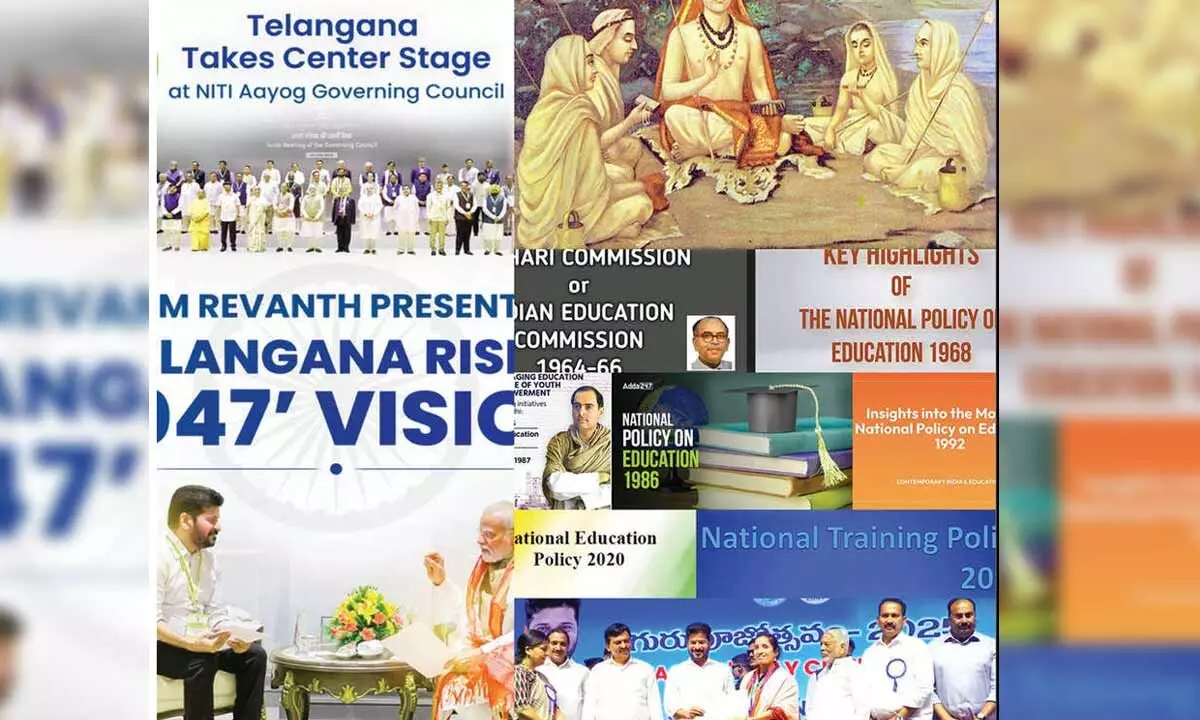
I feel such an exemplary initiative by Revanth Reddy instead of a total revisit, can be a thoughtful continuum, drawing from these proven frameworks, but tuned to the aspirations of today’s learners, teachers, and society at large, which he himself has suggested
Telangana Chief Minister A Revanth Reddy had announced recently that the Telangana New Education Policy (TNEP), slated to be introduced soon will bring significant reforms and ensure quality education to all sections. Earlier, the State Government formed a committee head by K Keshava Rao for formulating this policy to serve as a guiding document for ‘Telangana Rising 2047’ keeping in view the ‘National Education Policy (NEP)-2020’ guidelines, the specific education needs, aspirations of the State, and then submit its report by October 30.
The history of National and State educational polices has been a complex combination of achievements and failures, often associated with the whims and fancies of the incumbent political leadership. Yet, the system has come to stay as a challenge meeting the earlier and ever-changing needs. Dr DS Kothari, Indira Gandhi, Rajiv Gandhi, P V Narasimha Rao, and the recent initiative of Prime Minister Narendra Modi through Kasturirangan have brought many policies.
The 1966 Kothari Commission, formally the Education Commission, under the leadership of Dr Kothari, in its ‘Education and National Development’ report, recommended the common school system, the 10+2+3 structure, a focus on equity and scientific temper.
Based on its recommendations, Indira Gandhi’s NEP framed in 1968, emphasized compulsory education for children up to 14 years, the three-language formula, and focus on science and mathematics. Rajiv Gandhi’s ‘Challenge of Education: A Policy Perspective’ (1985) with inputs from K C Pant set the tone for yet another policy.
It was Narasimha Rao, as the then HRD Minister, who piloted the 1986 NPE focusing on universal access, adult literacy, Navodaya Schools, teacher training, and women’s empowerment. Subsequently, as the Prime Minister, Rao updated it in 1992 with support from the then HRD Minister Arjun Singh. The framework was reinforcing decentralization, curriculum renewal, and vocationalization, the process of integrating practical skills, technical knowledge, and career-focused subjects into a general education curriculum.
It is worth noting that this 1992 policy, crafted with foresight and political sensitivity, stood the test of time for nearly twenty-eight years without being replaced. Few education policies in the world have enjoyed such longevity. Its balanced approach, rooted in equity, relevance, and pragmatism, meant that successive governments across the political spectrum continued to adopt and implement it without questioning its fundamentals. This silent durability itself is an extraordinary tribute to the Congress leadership of that era and to the craftsmanship of Narasimha Rao both as a thinker and statesman. Since then, there was no new policy as such.
However, initiatives like Prof Yash Pal’s National Curriculum Framework, the Sarva Shiksha Abhiyan, the Right of Children to Free and Compulsory Education Act, Sam Pitroda’s National Knowledge Commission, and reform committees such as those chaired by Yashpal and TSR Subramanian steadily prepared the ground from time to time.
Dr Krishnaswamy Kasturirangan, former ISRO chief, gave shape to the NEP 2020 with Modi’s touch, replacing 10+2 education system with 5+3+3+4 structure. The idea has been to promote flexible, multidisciplinary and learner-centric education with a focus on foundational literacy, vocational integration, multilingualism, and digital learning. Parallelly, the DoPT, with support from ‘Professional Master Trainers’ like MP Sethy, who anchored successive National Training Policies (1996 and 2012), strengthened the training ecosystem to enable civil services move towards a competency-based model from mere capacity-building one.
Against this rich bank of policies, Revanth Reddy desires to have a new Telangana education policy. Having served as a librarian for 15 years in a State Government Junior College and in BHEL Higher Secondary School (KV model), and later as senior faculty for nine years at Dr MCR HRD Institute, I feel such an exemplary initiative by Revanth Reddy instead of a total revisit, can be a thoughtful continuum, drawing from these proven frameworks, but tuned to the aspirations of today’s learners, teachers, and society at large, which he himself has suggested.
Each of these efforts carried the same spirit, broadening access, enriching quality, and reducing inequity. The real challenge, as experience shows, was never the articulation of vision but its faithful execution on the ground. Telangana now stands at a juncture where it can learn from triumphs and shortcomings of these national experiences. The state’s own education policy must ensure that every child, regardless of social or economic background, experiences the dignity of quality learning. It should connect school education seamlessly with vocational and higher learning, while simultaneously investing in teacher training.
If this policy succeeds in bridging aspiration with delivery, vision with practice, it will not only stand as Telangana’s pride but also as a model for the nation. While shaping this policy, Keshava Rao may thoughtfully embrace the principle of ‘dynamic boundaries’ that allow growth and adaptation rather than static frameworks of temporary politics or narrow compulsions.
The noble task ahead is to revive and rejuvenate the education sector that was grievously neglected by the BRS regime.
The four ingredients, for serious consideration before drafting a healthy policy are: Education, learning, training and or appropriate deschooling (A process for children and parents alike when transitioning from traditional school to homeschooling).
If learning takes place without it leading to any worthwhile improvement, despite well meaningful policies on paper, it has no meaning. Only if learning from the primary stage itself is clubbed with contextual appropriate training by a professional teacher-cum-trainer, and later the methodology is shifted from ‘pedagogy to andragogy’ can the result be better and more complete.
Learning only through teaching especially as the child grows, which is a critical factor for success, may take time to achieve success, or even may be wrongly directed.
A thought may also be given for a ‘12-Year Comprehensive Education’ covering Vedic Studies, Upanishads, Shastras and Sanskrit, instilling values of compassion, service, modern education including communication, computer skills, and formal academics in tune with the Telangana State Open Board Society curriculum, before moving to degree or professional courses.
If executed with foresight, Telangana’s new education policy’ can stand not only as a tribute to its ‘educational legacy’ but also as a cornerstone for Telangana Rising 2047.


