
Hail the multi-headed HYDRAA

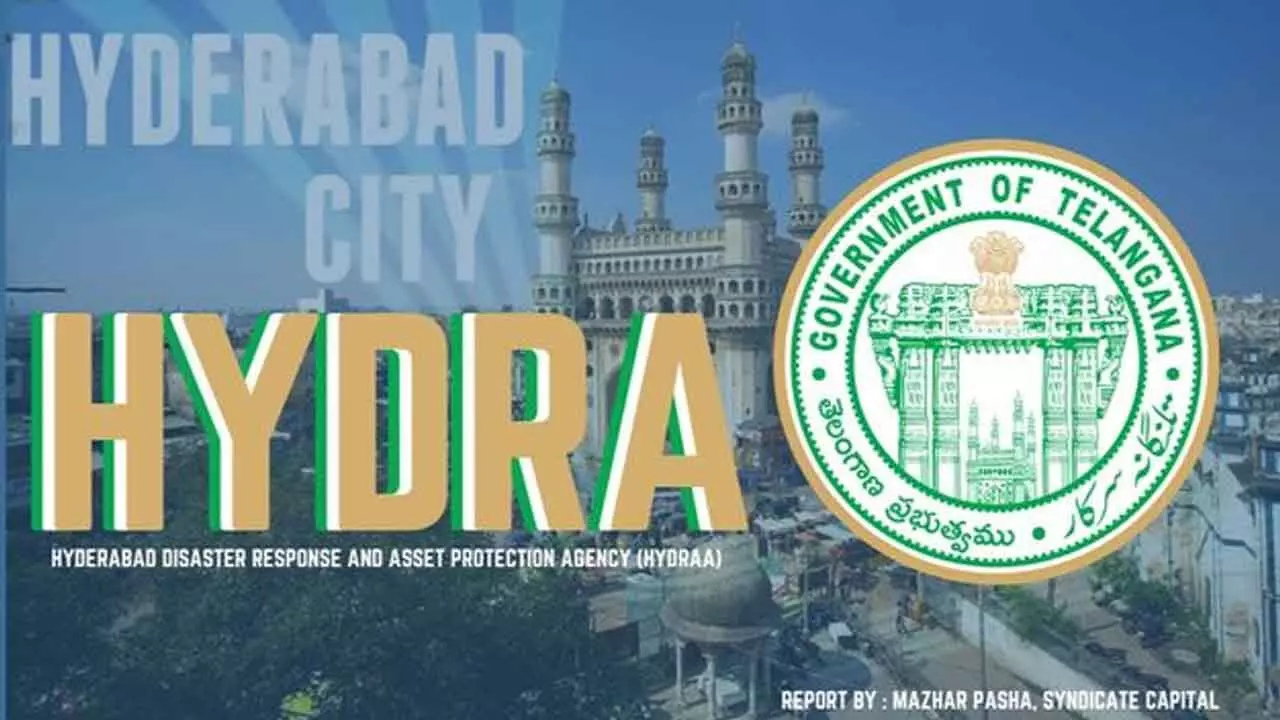
As Hyderabad continues to grow and evolve, HYDRAA (Hyderabad Disaster Response and Assets Monitoring and Protection Agency) will play a crucial role in guiding the city’s development. The HYDRAA protects natural resources like lakes, nalas and ponds and other public places of recreation, which are often at risk of illegal occupation and environmental degradation, maintaining the ecological balance, preventing illegal encroachments and ensuring effective disaster response.
A couple of days back, there was a gentle knock on the door around 4 pm. It was a very unusual time for any visitor to come knocking, especially when the dark clouds were threatening to empty. I opened the door fully expecting a salesman but was surprised to see the pretty 12-year-old Tamanna from my neighbourhood. She straight away walked up to the sofa and made herself comfortable and looked at me with her large curious eyes and a mischievous smile to go with it. Without any hesitation, she asked me, ‘Mam, what is Hydra?” I was stunned but even before I could give any reply, she shot a volley of questions and looked at me for answers with eyes wide open, as if it was a challenge.
I knew that my answers had to be perfect, and I could not goof up. So, without wasting a minute I started with the hydra of the animal kingdom, recollecting from my memory. We all know that hydra resembles a tiny delicate elongated sea anemone nut in real life, and is an invertebrate freshwater multicellular organism. It has a translucent trunk-like body that measures about 30 millimeters long, with the mouth at the top, rimmed with several long tentacles. Its locomotion is by looping, that is the whole-body somersaults.
When a hydra is cut in half, each half regenerates and forms into a small hydra; the head regenerates a ‘foot’ and the ‘foot’ vice-versa. It means basically that ‘hydra’ is invincible, has a long life and does not age. It is all powerful and no strength can diminish it.
Then I took her on a journey through the realms of the fascinating mythological world and explored the powers and weaknesses of the legendary Hydra, the serpent-like monster that appears in Greek mythology. The Lernaean Hydra in Greek and Roman Mythology, the offspring of Typhon and Echidna, was a gigantic serpentine lake monster with nine heads, (the number varies) one of which was immortal. The fearsome Hydra was one of the most intriguing creatures and its rejuvenating powers and deadly venom made it a formidable opponent. Its breath was poisonous to all who came in its path. It had superhuman strength and power to overpower heroes and monsters alike.
The hydra was highly resistant to powerful ‘opposition’ and ‘attacks’ and survived in harsh ‘unfriendly’ environments. It was vulnerable to fire otherwise it was indefatigable. Its weaknesses combined with the bravery and cunningness of heroes like Hercules made it possible to defeat this legendary monster through deceit. The curious Tamanna next asked me about the similarities between the ‘Hyderabadi HYDRAA’ and the mythical Hydra.
I decided to enlighten her about all the good work that was being done by the ‘Hyderabadi HYDRA’ (the name she coined).
As Hyderabad continues to grow and evolve, HYDRAA (Hyderabad Disaster Response and Assets Monitoring and Protection Agency) will play a crucial role in guiding the city’s development. I could see Tamanna’s uneasiness over the expanded abbreviation.
The HYDRAA protects natural resources like lakes, nalas and ponds and other public places of recreation, which are often at risk of illegal occupation and environmental degradation, maintaining the ecological balance, preventing illegal encroachments and ensuring effective disaster response.
In keeping with its avowed responsibilities, HYDRAA has reclaimed hundreds of acres of land around lakes and has been working to restore them. Apart from protecting public property and handling disaster management in the city, it also conducts anti-encroachment drives to remove illegal constructions from government land and water bodies.
On hearing this Tamanna applauded (her nearness to Eureka) with a big smile and said, “a great job.” Being an environmentalist, in her own way, who always discourages polythene carry bags, Tamanna felt sad and said, if not saved, in future the students would see water bodies only in books. Then came the difficult task of justifying the name and connecting it to the mythical Hydra.
In modern English, it describes a difficult or multifarious situation. It’s used to show that the person is all powerful. ‘Hydra’ can also be used figuratively to describe something that is hard to overcome or resist. Hydra represents difficult challenges, the dangers of nature, even the concept of evil that grows more formidable when faced head on.
As it symbolises long life is indicative of the fact that HYDRAA is here to stay. Its symbolism goes beyond its physical attributes. The constant struggle between good and evil and its ability to grow new heads and not lose the battle in spite of the opponent being very powerful denotes a never-ending battle against darkness, reminding us that evil that comes in many forms must be confronted and subdued relentlessly.
At the conclusion of my sermon, I looked at the all-excited Tamanna, who bade good-bye, and ran home with a war cry ‘hail HYDRAA.
Incidentally, the next day at her school, she would rattle the entire conversation in verbatim, typical of the Tamanna, I have known.


