
Gau Mata, the ‘shrine of compassion, culture and wisdom’

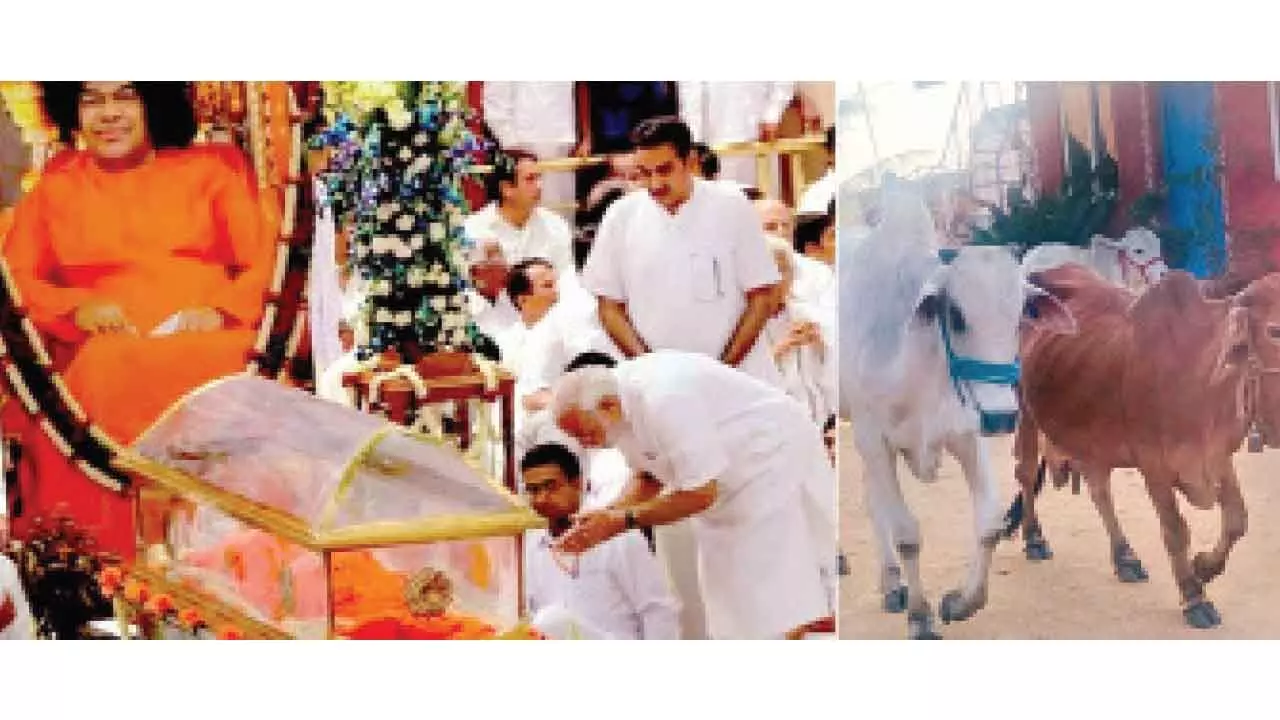
Modi mentioned Brazil’s success in adopting India’s Gir and Kankrej breeds and enhancing them through modern technology and scientific management. These examples, he said, reflect how tradition, compassion, and scientific thinking can together transform the cow into a symbol of faith, empowerment, nutrition, and economic progress. This spirit, he observed, is now being carried forward with noble intent in Puttaparthi. The cow, valued for its utility as well as revered as ‘Gomata’, the universal mother, nurturing the body, mind, society, and soul, is richly illustrated in our epics.
Participating in the birth centenary celebrations of Bhagwan Sri Sathya Sai Baba at Puttaparthi on November 19, Prime Minister Narendra Modi eloquently invoked the ‘central value of India’s great civilisational spirit.’
In a symbolic and compassionate gesture, he announced the donation of 100 Gir cows to support their economic, nutritional, and social well-being. His message emphasizing that cows reflect the country’s ancient wisdom, compassion, and ecological harmony, resonated deeply.
The timeless message of ‘seva-service’ was the heart of his address.
‘Each of the path of bhakti, gyan or karma is connected to Seva,’ Modi stated, recalling Baba’s guiding principle: Help Ever, Hurt Never.
Modi spoke passionately about Gau Mata, revered in Indian tradition as a motherly figure, symbolizing life, prosperity, compassion, and sustainability in the traditional Indian context. He highlighted the immense contribution of cows to rural economies and to global development, referring to the initiatives of Rashtriya Gokul Mission (RGM) in Varanasi and the inspiring Girinka tradition of African Nation Rwanda, where India gifted Gir cows. He reiterated that in India, cows are an embodiment of traditional knowledge, cultural values, and spiritual symbolism.
The Prime Minister shared his personal experience of participating in a ‘Gau Daan’ program, where 100 cows were donated to poor farming families. He emphasised how in Indian tradition, the cow represents sanctity of life, nurturing wealth, and collective well-being.
These cows, he noted, would support their recipients’ economic stability, nutritional needs, and social harmony. Modi remarked that the message of prosperity through cow protection is visible across the world. He took pride in the success of RGM, where the female calf born from a distributed cow is gifted free of cost to farmers in other regions, thus promoting sustainable cow population growth.
Sharing inspiring examples from across the globe, Modi spoke about Rwanda’s Girinka tradition, ‘May you have a cow,’ where the first female calf born is gifted to another family, ensuring shared prosperity. Modi mentioned Brazil’s success in adopting India’s Gir and Kankrej breeds and enhancing them through modern technology and scientific management, thereby turning them into superior dairy performers. These examples, he said, reflect how tradition, compassion, and scientific thinking can together transform the cow into a symbol of faith, empowerment, nutrition, and economic progress. This spirit, he observed, is now being carried forward with noble intent in Puttaparthi.
Ancient wisdom which emphasized reverence, compassion, and responsibility towards cows, as a living tradition that is being continued to inspire modern India was eulogized by Modi.
The cow valued for its utility as well as revered as ‘Gomata’, the universal mother, nurturing the body, mind, society, and soul is richly illustrated in our epics.
In the Valmiki Ramayana, king Vishwamitra once visited the hermitage of Brahmarshi Vashishta with his army. Vashishta welcomed him, and in true spirit of hospitality, arranged a sumptuous feast prepared by Shabala, the Divine Kamadhenu Cow. Astonished by her miraculous powers, Vishwamitra demanded that Vashishta give her to him.
Vashishta gently refused, explaining that Cow Shabala was his spiritual companion, the source of his peace, wealth, and wisdom. Even Kamadhenu proclaimed her relationship with Vashishta as spiritual. When the king attempted to seize her by force, she broke free and returned to Vashishta, who, out of compassion, permitted her to defend herself. In the process, from her emerged divine forces that defeated Vishwamitra’s army with ease, symbolizing spiritual energy that, divine prosperity, and dharma ultimately triumph over material might.
In the Vedas, Puranas, and Dharma Shastras, the cow is described as the living abode of divine energies. It is said that Brahma and Vishnu reside in her horns, Shiva in her forehead, the sacred rivers in her back, the Pitru Devatas (ancestors) in her hooves, and Mount Kailash in her stomach. Her milk is part of the sacred ‘Panchamrita’. Her entire body is said to hold sacred rivers, and her presence brings purity to the atmosphere. She is called the walking temple, the embodiment of sattva, peace, purity, and nourishing grace. Her presence is believed to purify the atmosphere, and her breath resonating Vedic vibrations. Circumambulating (pradakshina) is considered equivalent to walking around the sacred Universe.
Panchagavya, the five products of cow, the milk, curd, ghee, dung, and urine, is spiritually revered and scientifically acknowledged for their medicinal, ecological, and agricultural benefits. Modern nutritional science recognises the value of native Indian cow milk in enhancing immunity, cognitive function, emotional stability, and physical nourishment for infants, elders, and patients.
Even cow dung, rich in nitrogen and micronutrients, improves soil health, fortifies crops, and serves as fuel, disinfectant, and a natural pest repellent. Traditionally, it was used to plaster floors, purify surroundings, and sanctify ritual spaces.
Cow urine, with proven antimicrobial properties, is used to purify toxins and even support healing of chronic ailments. In villages, sprinkling it is believed to dispel negativity and restore harmony.
Our sages and scriptures have always glorified cows as the greatest wealth. Chyavana Maharshi declared that there is no treasure greater than cows. Spiritual Masters Valmiki, Vyasa, Adi Shankaracharya, Tulsidas, Kabir, the Buddha, Dayananda Saraswati, Chaitanya Mahaprabhu, Swami Vivekananda, and Mahatma Gandhi spoke passionately about cow protection.
Lord Krishna, the divine cowherd, grew up as Gopala, the protector of cows. Kings Dilipa and sage Jamadagni considered cow protection a sacred duty. Manusmrithi prescribed ‘Gau Daan’ (donation of a cow) as the highest form of charity. It was believed that feeding one hungry cow was equivalent to performing a grand yajna.
The cow, a fountain of emotional, ecological, economic, and spiritual abundance, besides nourishing the stomach, enriches the heart, mind, and soul. She teaches sacrifice without expectation, service without demand, and sustenance without pride. Her gentle presence inspires peace. Her silent patience teaches selfless love. The dust from her feet is holy and sacred, believed to bless, heal, and purify more powerfully than sacred rivers.
Recognising the importance of cows from across angles, for the first time in the state, Telangana Chief Minister A Revanth Reddy on June 17, envisaged a comprehensive cow protection policy, including establishing modern cow shelters (Goshalas) with adequate space for grazing and free movement. In a laudable directive, a three-member official committee was constituted to conduct an in-depth comprehensive study on all aspects of cows.
It may be apt to mention here that, recently, when I visited Planets Green Dates County, home to about 50 cows and a beautifully maintained cow shelter, adorned with a charming deity of Lord Krishna I was amazed. The reverence extended to ‘Gau Mata’ and the dedication to spread her profound message was deeply moving. I was awestruck by the serene scenes: cows gracefully moving, calmly feeding on fodder and water, calves suckling affectionately, and a skilled caretaker milking a cow with devotion.
India’s traditional practices centred around cow service in the context of today’s challenges, blend ecology with economy, spirituality with science, and compassion with cultivation.
Modi’s reminder that the cow is a civilizational symbol is both timeless and timely. To honour the cow is to honour life itself. To care for the cow is to care for creation. She is not just a giver of milk, but a giver of peace, prosperity, purity, and purpose. She is Gomata, the universal mother, the silent teacher, the spiritual companion, and the walking sanctuary of nourishment, purity, and divine grace.
Besides protecting and revering, let us learn from her, and recognize ‘Gau Mata’ as the ‘shrine of compassion, culture, and wisdom.’
Celebrating ‘Gau Mata’ implies honouring timeless heritage, embracing innovative sustainability, and envisioning a future where compassion, culture, science, and spiritual consciousness co-exist harmoniously, inspiring humanity to build a kinder, greener, wiser, peaceful, and inclusive world.
(The writer is Secretary of the Center for Brahmin Excellence)


