
Dr Kalam is right: Determination is the power that sees through all our frustrations and obstacles

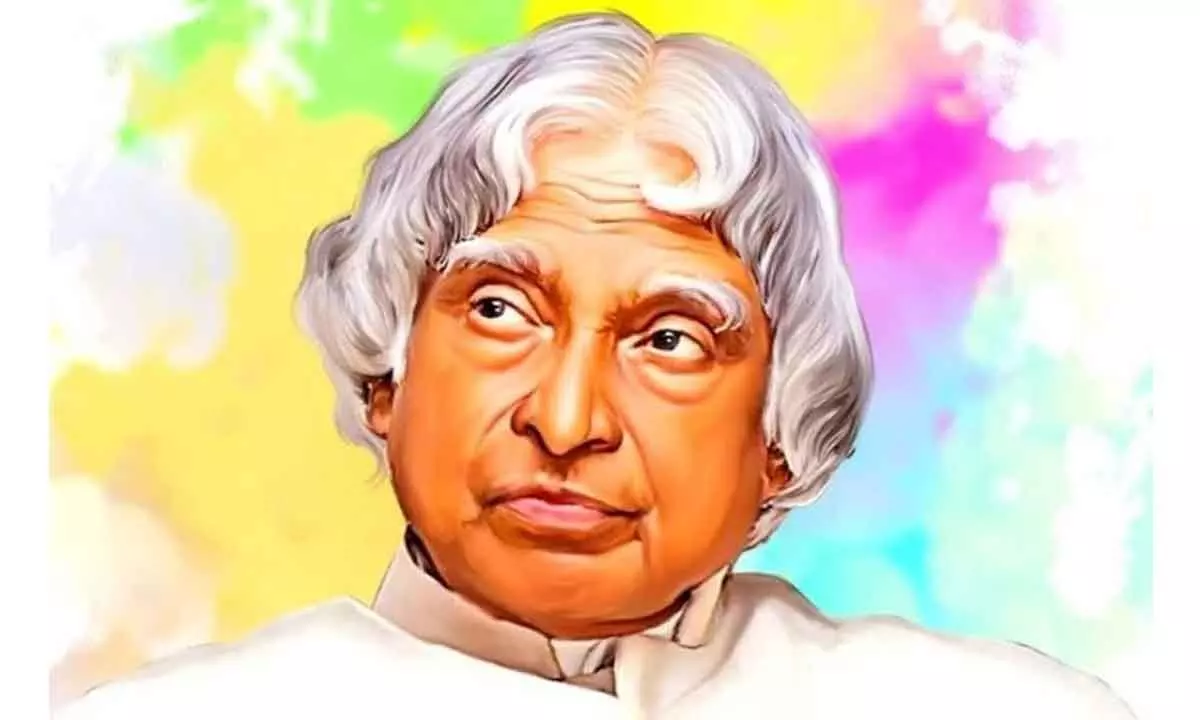
The nation fondly remembers Dr APJ Abdul Kalam on his 10th death anniversary (July 27) like it has been doing for the last nine years.
This is a time to reflect on the remarkable life, achievements and the extraordinary legacy the ‘Missile Man of India’ and ‘People’s President’ has left behind. Dr Kalam’s significant contributions to the country’s space and defence programs and as the President and his vision for a developed India continues to inspire generations, including in pursuing careers in STEM (science, technology, engineering and mathematics). Dr. Kalam’s humility, determination, and commitment to public service and his desire to see India as a knowledge super-power serve as a role model for individuals seeking to make a positive impact. His pearls of wisdom and life lessons continue to motivate the younger generations to dream big and act with conviction.
Abdul Kalam was known for his simple and humble demeanor. He often described himself as a short man with undistinguished looks especially when compared to his tall and handsome parents. He possessed a warm and genuine smile that endeared him to many. His appearance reflected his inner simplicity and approachable nature. He was often seen as a man of the people, connecting with individuals from all walks of life. His long, signature hair style, parted in the middle and often described as “dreadlocks”, became a part of his persona. There is no exaggeration that Kalam’s hairstyle too has numerous fans.
Driven by the belief that only a strong technologically advanced nation can achieve international recognition and command respect, he agreed to spearhead the Integrated Guided Missile Development Program (IGMDP) in 1982. This was DRDO’s quest to achieve self-reliance and shed external dependence on missile technology.
Not one to rest on laurels after inspiring missiles ranging from Agni, Prithvi, Akash, Trishul and Nag, Dr Kalam’s relentless pursuit of technological excellence fell on an unfinished supersonic combustion engine during a visit to Russia in 1993. This formed the genesis of the BrahMos missile project, a joint venture of India and Russia. It takes its name from the River Brahmaputra and Russia’s Moskva. It is this very missile that broke Pakistan’s spine and brought it to its knees during Operation Sindoor.
Brahmos stands as a testament to the technological prowess achieved under Kalam’s guidance and integrating indigenous expertise with international collaboration. BrahMos marked India’s emergence as a global missile power and a defense arms exporter. Dr. Kalam’s vision, leadership and scientific acumen transformed India’s defence landscape.
We turned the tables on the world, while it became the backbone of a large-scale military operation, proving that India’s ambition to be Atmanirbhar is not just aspirational, but action driven.
Soon after assuming power in March 1998, the then prime minister Atal Bihari Vajpayee had a high-level discussion with Kalam and Dr Rajagopala Chidambaram, Director of BARC, and conducting nuclear tests was on top of theagenda. The tests consisted of five detonations. The tests were collectively called Operation Shakti.
Kalam played a pivotal role in the 1998 Pokhran-II nuclear tests, serving as the key organizer and scientific advisor to the government. He was instrumental in coordinating efforts between DRDO, BARC, and the armed forces to ensure the success of the tests that were kept top secret. People in the nearby villages were terrified, the earth shook, the sky was covered with smoke while Vajpayee announced that India had become a nuclear power with Pokhran II.
Almost immediately, India was subject to economic sanctions by Japan and the United States. On the other hand, India emerged stronger and solidified its position as a nuclear power. Kalam became a national hero overnight. He evolved a national strategy called “Technology Vision 2020”, which was the blueprint for the country’s missile saga.
The missile man had an overbearing humane touch. I was blessed to have met this great human being a couple of times.
The first time I was face to face with him was as a member of DRDO ladies’ group. We were invited to Rashtrapati Bhavan for breakfast. Meeting the President over breakfast was not an ordinary thing for an ordinary human being like me. As he had a pressing engagement, we were informed that he would join us later.
What followed was an unbelievably emotional gesture. Dr Kalam arrived holding steaming idlis and hot wadas in both hands. He offered them to us, while apologizing for joining late. I was speechless and amazed to see the country’s first citizen and the globally revered ‘Missile Man’, in his entire down-to-earth and unpretentious humility.
With a warm smile he said he was illiterate as regards food technology. He admired the ladies for their prowess in cooking.
One of our members said “Sir, this is the only job we know’’. He came a little closer and said “Food is the basic requirement for every one of us. The country’s strength and future lie on women. The foundation for a strong India is entirely on them. If men and children are successful in life, it’s because of the mothers of this great country. With empty stomachs nobody can think of science and technology.”
Here was the man simple and humane to the core, who valued the dignity of every individual, regardless of their job or status. His words taught me that compassion, consideration and concern are the key to life and being accessible to your people in whichever situation you are in is very important.
All those who were associated with him experienced his warmth and affection. A DRDO scientist urgently needed to be transported to London in a medical emergency. Kalam left no stone unturned till the scientist returned to the country in perfect health. Such was his concern for his people.
Dr. Kalam was convinced that children are the future of the country, and one had to ignite their minds. It was towards this that he dedicated himself to the cause of igniting their minds. He said he would interact with at least one lakh children in a year. He was deeply disturbed by the societal connects. He always remembered how his father and the high priest of Rameswaram temple could discuss Bhagwat Gita and Quran in their houses. He always mentioned how a church was transformed into a technology laboratory and became the birthplace of the nation’s rocket technology. To him that was the fusion of science and spirituality, and he wished such fusion to happen in all fields in continuum.
Dr. Abdul Kalam worked on the vision of transforming India into a developed nation, powered by economic growthwith a value system. His vision was a ‘developed’ India, which can be accomplished only if each citizen of the country says in true Kalam spirit; “Yes, I can. Yes, India can. Yes, India will”.
That is the finest tribute we Indians can pay to Dr. Abdul Kalam.


