
Beholding thousand full moons, rare privilege

‘SahasraChandra Darshana’ is a rare celebration, sanctified by Vedic Vision of Samskaras, which guide human beings as milestones, connecting each individual to society, nature, and the cosmic order. ‘Sanatana Dharma’ treats individual’s journey from ‘Conception to Accomplishment’ across time, stage by stage as sacred, ensuring continuityand meaning in life. Samskarasblessand purify life frombeginning until the rare privilege of beholding thousand full moons, and in exceptional cases till theone-hundredth birthday.
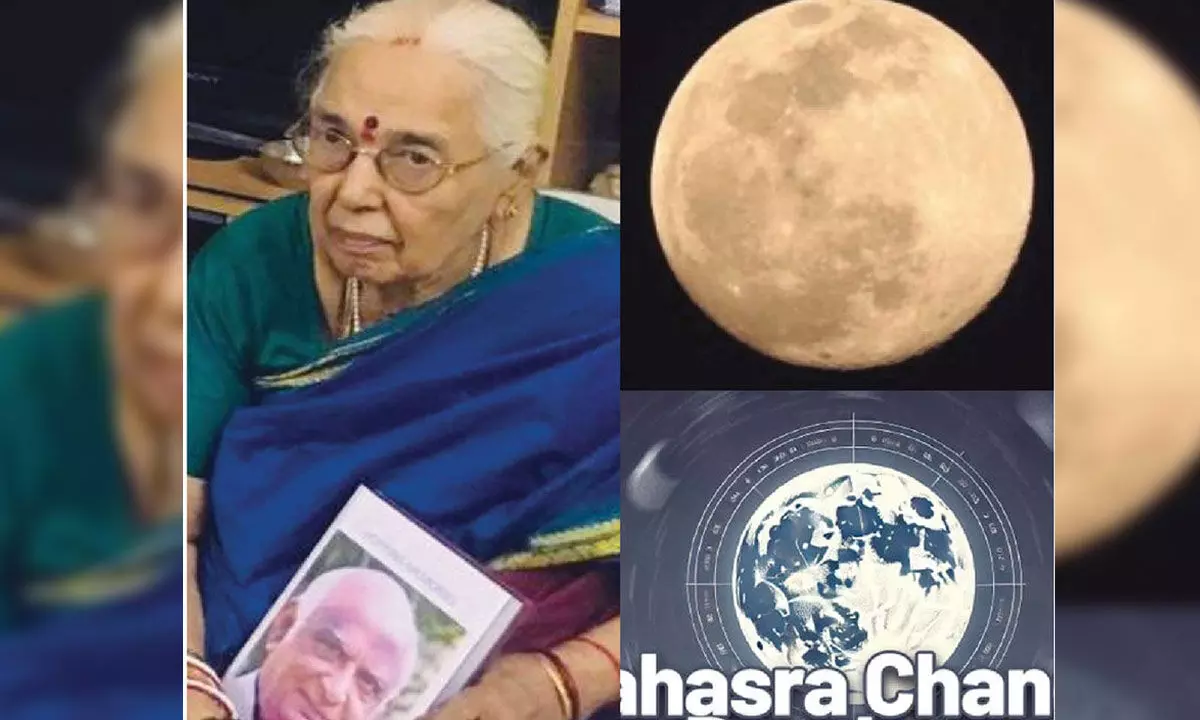
On September 7, Aitharaju Karuna Ranga Rao completed sighting the One-Thousandth Full Moon. To honor this sacred milestone, her son Dr Bharath Babu, and grandson Ved Varun are organizing the Cherished Ancient Vedic Festivity, ‘Sahasra Chandra Darshana’ on October 6, that marks longevity, fulfillment, and gratitude. It honours the individual to offer blessings to younger generations and learning lessons. karuna will also have another rare privilege of seeing the Full Moon 1001st time the same evening.
Karuna, an accomplished Telugu lecturer, did his post graduation in 1964, from Osmania University when Professor Khandavalli Lakshmi Ranjanam, the doyen of Telugu literature was Head of the Department.Distinguished Divakarla Venkatavadhani, Palla Durgaiah, Biruduraju Ramaraju, Chalama Charla Rangacharyulu etc. were other Professors. She meticulously scripted a unique 66-day North India Pilgrimage, which is an authority, based on the diary of her illustrious Father-in-Law, in such a lucid style that it depicted literally the Google Map.
Observing ‘Shodasha Samskaras’ (sixteen) has been enduring. Garbha Dhana, the first Samskara, takes place before conception, invoking divine blessings for a virtuous progeny, which even Manusmrithi emphasises. Prior to this, the scientific formalities performed after the first menstruation, are blessings for the Girl, who stepped into womanhood, honouring the wisdom of mothers and grandmothers. After conception, the foetus is nurtured and protected through rituals in third and ninth months, such as Simantonnayana (modern baby shower), literally means ‘Parting of the Hair Upwards.’ Vedic Chants or protective prayers are recited for the health of mother and child.These are sort of collective celebration, reminding that, birth is never an isolated event but a blessing shared by family and community.
The first day of birth is marked by Jatakarma, by offering prayers for the newborn’s vitality. Honey or ghee is touched to the baby’s lips to invoke health and long life. On the eleventh day, mother and child are bathed ceremonially, signifying purification. On the twenty-first day, the Namakarana or naming ceremony is performed, giving the child lifelong identity. A symbolic first outing or Nishkramana, of the baby to see the sun and the world or the initiation into the larger universe takes place same day. The first tasting of solid food, Annaprashana, signifying the transition from dependence on the mother’s milk to the wider nourishment of nature is performed in the sixth month. Families often place playful objects before the child to guess future inclinations. Around the age of three follows Chudakarana, the first tonsure. The hair grown since birth is shaved off, symbolizing the removal of impurities and impressions from past births. Aksharabhyasa, the ceremonial initiation into knowledge, is for enabling the child writing the first letters, invoking Wisdom Goddess Saraswati.This sacredfoundation of dharmic livinglays the path to teaching the child that, learning is lifelong pursuit.
Upanayana, the ‘Second Birth’ and regarded as intellectual and spiritual, complementing the physical birth as the sacred thread ceremony, inducts the child, traditionally boys of Brahmin, Kshatriya, and Vaishya families, into a life of disciplined study. The child becomes a Brahmachari, devoted to chanting the Gayatri mantra, learning the Vedas, and practicing self-control, service, and humility. Marriage (Vivaha) is regarded as the great Samskara that enables the continuation of family and dharma. It is a personal union, a soulful celebration of togetherness, tradition, bonding, and responsibility, drawing families and friends into one harmonious bond.
The ceremonies begin with Nischitartham or engagement, fixing of an auspicious Muhurtam, and preparatory rites such as Pasupu Kottadam, where turmeric paste is applied to the bride, and Sanagalla Raayi Veyadam, where soaked Bengal grams are placed beneath a grinding stone. Edurukolu marks the ceremonial welcome of the groom. In Snatakam, the groom symbolically undertakes a pilgrimage to Kashi, representing renunciation of worldly ties before embracing the solemn duties of a householder. The bride performs Ankurarpana, sowing nine types of seeds in a mud-filled vessel, tenderly watering them as a symbol of fertility, growth, and the nurturing role she is to assume. Rituals like Vara Pooja, honoring the groom, and Gouri Pooja, where bride seeks blessings of Goddess Gouri for harmony and prosperity, complete the preparations.The central rituals to uphold Grihastha Dharma in marriage include Kanyadaan, the giving away of the bride as a cherished gift, and Panigrahana, the groom’s symbolic holding of her hand to signify responsibility and care.
The playful application of Cumin and Jaggery paste to both bride and groom reflects the sweetness and strength expected in their relationship. Tying of the sacred thread Mangalya Dharanamarks their inseparable bond, and Saptapadi, the seven steps around the sacred firesolemnize their vows of equality, unity, and shared duty. The bride’s family formally entrusts Bride to her in-laws, symbolizing the blending of two families, in Appagintalu.
On completion of sixty years,normally to the husband, Shashti Poorti is often celebrated as a renewal of marriage vows. The couple once again perform rituals together, reaffirming their bond. At seventy-five, a similar celebration may be held, honoring the elder’s wisdom and years of service to family and society. If one reaches the rare milestone of a hundred years, the occasion becomes a collective thanksgiving, reminding all that longevity itself is a divine blessing.
Sahasra Chandra Darshana, around the age of eighty-one years and four months is the most revered longevity ritual, primarily as the thanksgiving to the divine for the gift of a long, fulfilled life. Families and communities gather around the elder, honoring the elders for their journey, while the elders in turn bless the younger generations. The full moon symbolizing completeness, purity, and the rhythmic flow of time, becomes a fitting emblem for a life that has ripened fully. Sahasra Chandra Darshana is both personal andcollective, reminding all, of the cycle of life, and the continuity of generations.AitharajuKaruna is one among the few blessed one to reach this stage.
Let us also comprehend little bit of the four Ashramas or stages of lifedescribed in Dharma Shastras. Brahmacharyais the period of discipline and learning.Grihasthais the householder stage.Vanaprasthais the beginning of detachment.Finally, Sannyasa, renunciation to be freed from worldly bonds. However, these stages areflexible, teaching that life must balance duty, desire, and liberation.
At the heart of this vision lies the doctrine of the Purusharthas, the four aims of life. Dharma provides the ethical foundation, Artha gives the means, Kama offers the joys of life, and Moksha promises ultimate freedom. Samskaraswere designed ensuring that life would be a balanced journey of duty, joy, responsibility, and liberation, reminding that it is not merely survival or achievement but sanctity and responsibility, in relation to family and society.
In an age of rapid change, where science, medicine, and technology constantly reshape human life, the samskaras still remind that,they are not frozen ceremonies of the past but living traditions meant to adapt and endure. For instance, the child now maybe initiated into learning through digital tablets instead of slates, but the spirit of Aksharabhyasa, that knowledge is sacredremains unchanged.
Longevity may be extended through medical advancements, yet the celebration of Sahasra Chandra Darshana conveys the same timeless message. From ‘Conception to Sighting Thousand Full Moons’the Samskaras remind humanity that life is sacred, and that family, community, and society remain its essential anchors.
Printed & Published by K. Hanumanta Rao on behalf of M/s Hyderabad Media House Pvt.Ltd and Printed at Survey No - 713/P, Near Sundara Chaitanya Ashram, Dundigal Village, Quthbullapur Mandal, Medchal Malkajgiri (Dist) - 500043 and published from Hyderabad Media House Ltd, Plot No.1042, Road No. 52, Jubilee Hills, Hyderabad-500033, TELANGANA.Chief Editor:P Madhusudhan Reddy. RNI No: TELENG/2011/38858


