
Ambedkar, Constitution Day and morality

Constitutional integrity should ensure stability of the legal framework and guarantee that governance is predictable and fair. In functional democracy, people need constitutional integrity, which refers to the state of the Constitution being whole, sound, and unimpaired. It is about maintaining the basic structure, coherence, and fidelity to its foundational principles.
It was a Red-Letter Day for the people of the country when the Constitution was adopted on November 26 in 1949. It gave birth to the functioning of aspects like citizenship, elections, and the provisional Parliament. It was a day to cheer for B R Ambedkar, who saw the rule of law fully notified on January 26. Unfortunately, he saw the constitution’s functioning and the Government of India’s administration for only six years after passing away on December 6, 1956. Incidentally, his died three days after he completed the final manuscript for his book, The Buddha and His Dhamma.
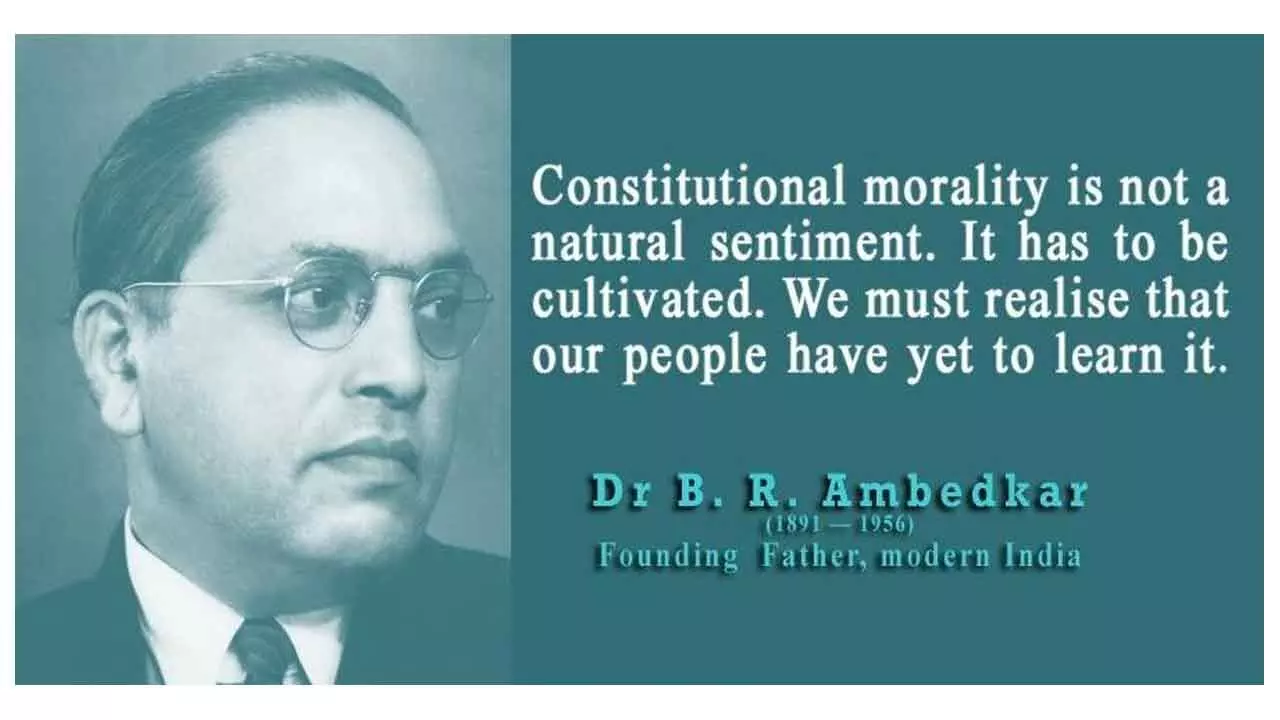
Dharma was recognised as the national motto in the form of Satya meva Jayathe. Ambedkar expected that Constitutional morality would help in building our nation. Satya meva Jayathe stands for ‘morals, ethics, and not lying or avoiding falsehood’. Even if there is a serious violation of the provisions of the Constitution, it does not have the power to punish the violators, which is a shocking fact.
A code of morality:
The entire Constitution is a code of morality. We need to understand this. There is no penal code or penal constitution. On any given day, we violate this morality. Breaking an oath and destroying ethics is commonplace.
I was surprised to know that somebody had to file a petition under the Right to Information Act to tell the truth! Will that ‘public information officer’ tell the truth? Is it a morality code or a penal law that imposes a penalty for not giving information? Whether the wife is entitled to know the monthly salary of the husband was before me as Central Information Commissioner.
Do we have Constitutional Morality?
In fact, there is no such thing as ‘constitutional morality’, but one can understand that it is the core philosophy and ethical code embedded in the Indian Constitution. It means adhering not merely to the letter of the law, but to its spirit and fundamental values (like equality, liberty, and fraternity). It is an essential check on majoritarianism and arbitrary power, often championed by the Supreme Court.
Protecting basic democracy is constitutional morality. It is the basic structure of our Constitution. If Ambedkar were alive and available, he would have surely incorporated it as an important part of our Constitution, at least in the Preamble. Ambedkar should have used the concept of PIL, which has totally changed the structure of functioning of the Supreme Court and our governance and democracy. It is the conscience of the Constitution.
Constitutional morality is expected to prevent tyranny. It acts as a higher standard to prevent the elected majority from using its power to violate fundamental rights or principles.
The dominant majority can protect itself. But what about the minority? Morality ensures that the rights and interests of minority groups are upheld, even if unpopular with the majority. The Constitution is expected to be dynamic, not just a legislative statement with some power, as passed by most MPs. This dynamic evolution allows the Constitution to adapt to changing societal needs and values without requiring frequent formal amendments.
Simultaneously, it has its own issues, primarily ‘constitutional morality’, an ambiguous concept allowing judges to impose their personal values or political ideology in the name of “morality.” We need to protect the basic structure of our constitutional democracy from personal values and political ideology. Lest one forgets, the 130th Amendment was made in a hurry.
Advisory opinion of the Supreme Court:
Is it a moral guide or a binding precedent? The Supreme Court’s November 20, 2025, judgement, an advisory opinion on a Presidential Reference, stated that the judiciary cannot impose fixed timelines on the President and Governors for processing state bills. The decision clarified that while prolonged inaction is unconstitutional and subject to limited judicial review, the specific timeframes previously suggested by the court were an overreach of judicial power. The absence of a strict, enforceable timeline may allow Governors to sit on bills for extended, potentially unreasonable periods, thereby stalling governance and thwarting the will of elected state legislatures. Critics argue that the decision empowers the central government-appointed Governors to undermine the rights and legislative agenda of non-BJP-ruled states, which can strain Centre-state relations.
Is the apex court dominating?
Critics argue that excessive reliance on constitutional morality can lead to the judiciary encroaching upon the legislative or executive domains. One can find many examples under the head of Governance and Parliamentary democracy. Again, the 130th Amendment can be quoted as an example.
It may lead to friction between the judiciary and the legislature/executive when constitutional-morality-based rulings invalidate popular legislation.
Upholds rule of law:
Constitutional integrity should ensure stability of the legal framework and guarantee that governance is predictable and fair. In functional democracy, people need constitutional integrity, which refers to the state of the Constitution being whole, sound, and unimpaired. It is about maintaining the basic structure, coherence, and fidelity to its foundational principles.
However, the constitutional propriety refers to the ethical and appropriate behaviour of all constitutional functionaries (President, Governor, Speaker, MPs, MLAs, judges, and the likes) in accordance with the established norms and conventions of the Constitution.
Before that, we need to promote trust. Constitutional propriety, especially, builds public faith in democratic institutions by ensuring office holders act responsibly and impartially.
Written law but vague in practice:
The government and politics are making work difficult and rigid. One should avoid that rigidity. Strict adherence to integrity can sometimes hinder necessary constitutional evolution or reforms needed to address new challenges.
Constitutional Criminality and civil wrongs:
These concepts, particularly Constitutional criminality, are not formal legal terms but are used in political/academic discourse to describe deep-seated failures of the constitutional system.
Criminality: The wilful, systematic, or widespread violation of constitutional duties, fundamental rights, or the basic structure by those in power, often for political gain. For instance, mass defections and deliberate institutional sabotage.
Identifies systemic failure: Helps expose and name the gravest threats to democracy that go beyond simple legal violations like crimes against the constitution). The problem is that the risk of politicization could be weaponised by political opponents, diluting its meaning and turning it into a mere political slogan. However, the constitutional civil wrongs are different. Actions by the State or its functionaries that cause injury to citizens by violating their constitutional rights, leading to claims for compensation (police brutality and illegal detention).
Slow litigation: Like all civil remedies, enforcement can be delayed due to the slow nature of the legal process. Like working out a remedy for anti-defection, which, after amendment, turned into a ‘penal’ code to some extent. The Indian Constitution has rejected both Left and the Right approaches. Unfortunately, governance is destroying the morality of the Constitutional left, right, and center. Now there is a need to discuss Constitutional criminality and democratic morality vis-à-vis Constitutional integrity; constitutional morality; constitutional criminality; constitutional civil wrongs; constitutional propriety and constitutional democracy
(The writer is Professor and Advisor, School of Law, Mahindra University, Hyderabad)


