
Crash, cover-up and caste: India’s rot runs deep
Red tape; deadly silence: Who killed AI 171?
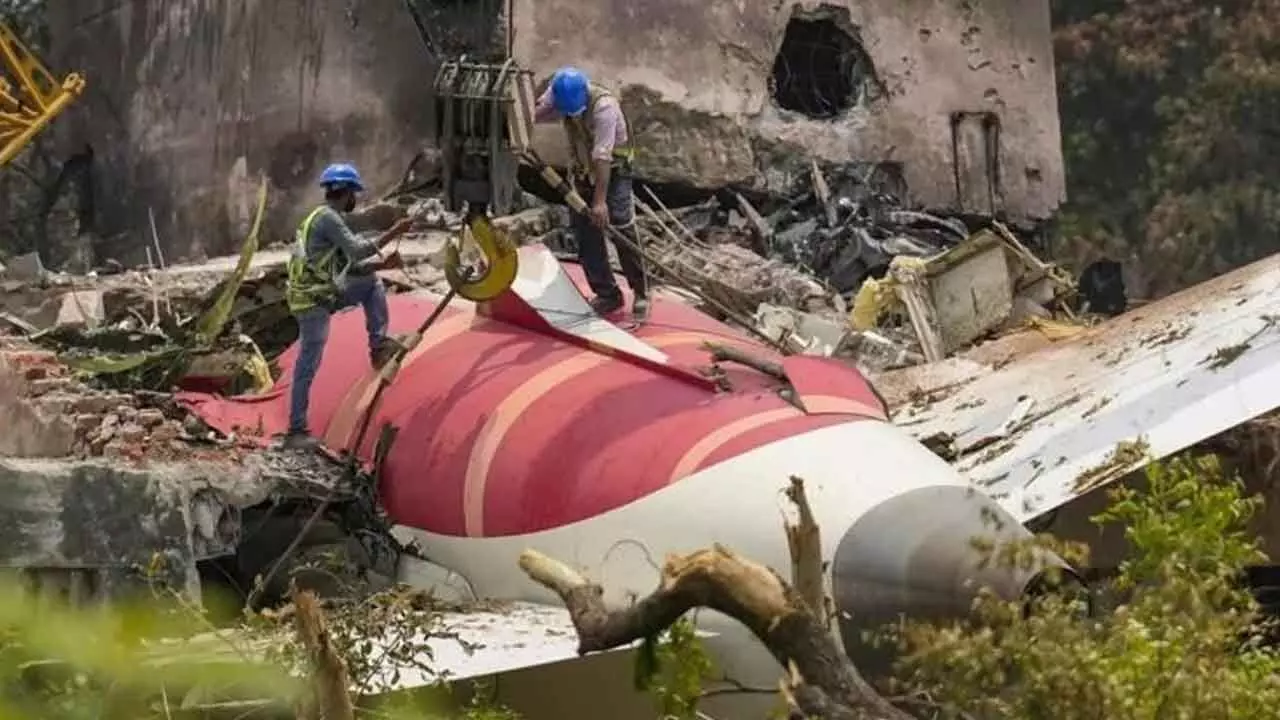
India’s bureaucratic inertia is once again under scrutiny following the tragic crash of Air India Flight 171, which claimed over 170 lives. The preliminary investigation reeks of evasion—shifting blame to pilots who can’t defend themselves, ignoring critical technical red flags, and conveniently glossing over earlier global safety warnings. While the government remains tight-lipped, and regulators delay action, the real victims—Indian passengers—are left without answers. The Congress party too remains silent, except when it finds a chance to peddle identity politics, as seen in Rahul Gandhi’s bizarre caste-based commentary on India’s space mission. It’s time to ask: will India’s power circles ever choose truth, merit, and accountability over cover-ups, red tape, and hollow political grandstanding?
Will India’s bureaucratic mindset ever evolve? Will the so-called babus ever learn to say “Yes”, as Prime Minister Narendra Modi once exhorted? Judging by the current state-of-affairs—particularly in the civil aviation sector—this hope still seems far-fetched.
The Prime Minister’s vision of “Sabka Saath, Sabka Vikas” continues to run into a brick wall of bureaucratic opacity and red tape. The most damning recent example is the handling of the June crash of Air India Flight 171 in Ahmedabad, which claimed over 260 lives.
The preliminary report by the Aircraft Accident Investigation Bureau (AAIB) raises more questions than it answers. Is the subtle attempt to blame the pilots an effort to protect Air India, the Directorate General of Civil Aviation (DGCA), or perhaps Boeing? Whose interests are being served here? Certainly not those of the passengers who lost their lives.
The report quietly insinuates pilot error—convenient, given that both pilots are dead and cannot defend themselves. Civil Aviation Minister Ram Mohan Naidu insists it’s too early to jump to conclusions, but the very language of the report reads more like an exercise in blame-deflection than a search for truth. This column had earlier raised alarms about the DGCA’s lack of transparency. The current report only reinforces those fears.
One of the most disturbing aspects is that the AAIB panel reportedly did not include any experienced pilots. Worse, it skirts crucial technical possibilities like software or mechanical failures. According to aviation experts, the act of switching off both engines’ fuel controls manually within 0.1 seconds—what the report attributes to pilot error—is virtually impossible. It would require superhuman synchronicity.
Adding to the dubious narrative, media reports hinted at possible suicidal tendencies in one of the pilots. That too collapses under scrutiny. Captain Sumeet Sabharwal, 56, was a seasoned flyer with over 15,600 flight hours, more than 8,600 of them on Boeing 787s. He was nearing retirement and planning to care for his elderly father. First Officer Clive Kunder, 32, had over 3,400 hours of flying experience and was soon to be married. Neither showed any signs of emotional instability. These are not the profiles of men on the edge.
This is not how a credible investigation is conducted:
Worse still, the Wall Street Journal accessed and published the report a full 24 hours before its official release in India. Who leaked it? And why was the Indian public kept in the dark?
Shockingly, even after the Journal and other international media pushed a narrative of human error, the DGCA, Civil Aviation Ministry, and AAIB failed to issue a firm rebuttal. It took five days for the Minister of State for Civil Aviation to make a bland statement urging the public not to speculate and wait for the final report. That’s not leadership; that’s abdication.
At the heart of the tragedy is a chilling fact: Both engines’ fuel control switches were moved from ‘run’ to ‘cutoff’ within seconds of take-off. One pilot reportedly asked the other, “Why did you cut off the fuel switch?” The reply: “I didn’t do it.”
Yet the AAIB chose to paraphrase this cockpit conversation rather than quote it verbatim. Why omit such a crucial detail? Is this ambiguity deliberate—intended to protect Air India and Boeing?
Former pilots insist it is nearly impossible for both switches to be accidentally moved in perfect synchronisation within 0.1 seconds. If true, the real culprit could be a systemic or software-related failure.
Equally damning is the DGCA’s inaction despite a 2018 bulletin from the U.S. Federal Aviation Administration (FAA) warning about the disengagement of fuel switch locks on Boeing aircraft, including the 787—the same model involved in the Ahmedabad crash. India’s regulator sat on this alert for seven years.
No fleet-wide inspections were conducted. No corrective directives were issued. Even after the crash and release of the AAIB’s preliminary findings on July 11, the DGCA waited until July 14—after a conveniently timed long weekend—to order checks. Meanwhile, Etihad Airways and UK aviation authorities launched immediate inspections.
What explains India’s delay? Gross negligence? This lethargy can cost lives. The Civil Aviation Ministry and DGCA owe the nation answers.
The report’s silence on cockpit voice recordings is another red flag. Transparency in aviation safety is non-negotiable. But instead of facts, we get fog. Instead of accountability, we get spin. Even more appalling is the political silence.
The opposition, so quick to erupt on issues of caste and religion, has maintained an eerie silence. Where are their calls for justice and transparency? Rahul Gandhi, in particular, squandered an opportunity to raise serious questions. Instead, he continued his tiresome identity-politics circus, questioning why Shubhanshu Shukla was chosen for the Axiom space mission and lamenting the absence of a BC candidate. He made similar caste-based objections during the Agniveer recruitment drive and even the Miss India pageant. He continues to display his grandmother Indira Gandhi’s Emergency mindset and threatens that “Babbar Sher,” of Congress will put Assam CM behind bars.
Congress should first examine its own track record. Since Independence, it has had only two Dalit party presidents: Babu Jagjivan Ram and, more recently, Mallikarjun Kharge. For a party so obsessed with representation, the hypocrisy is glaring.
Coming back to the crash—India’s preliminary accident reports typically only outline what happened, not why it happened. Some argue the AAIB report is more detailed than usual. But a closer read reveals the same bureaucratic DNA: vague summaries, missing transcripts, and no serious probing.
This isn’t just bureaucratic apathy—it’s a systemic rot. In any truly accountable democracy, this tragedy would have triggered a nationwide reckoning: a hard look at aircraft safety protocols, regulatory failures, and corporate collusion.
Air India’s CEO rushed to declare there was “nothing wrong with the aircraft.” Then why did it fall out of the sky? He offered no answer, merely hinting—again—at pilot error.
This crash wasn’t just an aviation disaster. It was a mirror held up to India’s broken regulatory architecture, a culture of bureaucratic cover-ups, and a political class more interested in optics than outcomes.
Unless this changes, “Sabka Saath, Sabka Vikas” will remain just a slogan—spoken from the podium but ignored in the cockpit of governance.
(The author is former Chief Editor of The Hans India)


