
Bihar’s battle turns into Bollywood potboiler: Stars, symbols and slogans collide
Rebels, rifts and rhetoric: Ballot battle turns ugly
With less than 15 days left for the first phase of polling, Bihar’s election campaign has entered a shrill and high-stakes phase. In this fierce battle, 1,314 candidates will test their fate on November 6. For both the NDA and the Mahagathbandhan (MGB) alliances, the battle has become a prestige issue. Leaders are making frantic rounds while voters, poker-faced, keep everyone guessing. It certainly is going to be a tough and interesting battle.
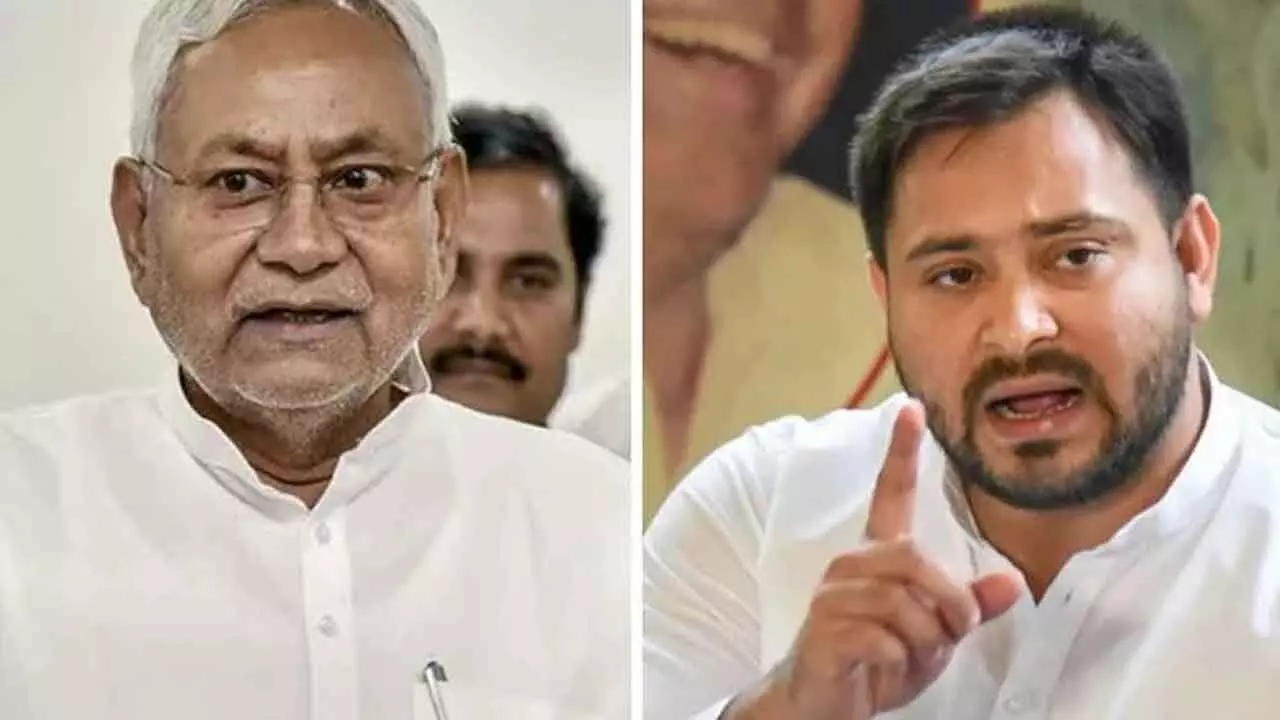
The first phase covers 121 constituencies, featuring direct contests between the ruling National Democratic Alliance (NDA) and the Opposition INDIA bloc. This will also test the popularity of Chief Minister Nitish Kumar’s JD(U) and Lalu Prasad Yadav’s RJD.
Deputy Chief Ministers Samrat Chaudhary (Tarapur) and Vijay Kumar Sinha (Lakhisarai) are in the fray, while the Election Commission is simultaneously preparing for a nationwide revision of voter lists from November.
After days of rift and wrangling over seat-sharing, the Mahagathbandhan held a joint press conference on Thursday to project unity. Tejaswi Yadav attempted to flip the narrative, declaring that unlike the NDA, the opposition had shown cohesion by announcing its CM and deputy CM candidates. He exuded confidence that the MGB was poised for power.
But the show of unity was undercut by discord within the Congress. Several Bihar Congress leaders staged a protest demanding removal of AICC in-charge Krishna Allavaru, accusing him of being a “corporate agent” and an “RSS sleeper cell.”
Rahul Gandhi—who had earlier thundered about “vote chori” and “vote chor gaddi chhod”—was conspicuously missing, even from party posters. His absence sparked whispers of a quiet surrender to Tejaswi. Congress observer Ashok Gehlot, however, announced that Tejaswi Yadav would be the MGB’s CM face, and Mukesh Sahani of the Vikassheel Insaan Party (VIP) its deputy CM candidate. A joint manifesto is expected soon, with Priyanka Gandhi Vadra and Congress chief Mallikarjun Kharge set to campaign from October 28.
The big question is why has the Congress settled for just 60 seats. In 2020, it contested 70 and won only 19. Despite bargaining for 74, it had to relent. Though RJD calls it a key ally, the deputy CM post went to a smaller party, VIP. Has Congress surrendered to RJD?
Now the question arises why NDA is shy of announcing the name of Nitish Kumar as CM? The opposition has a valid argument as it feels that BJP like in Maharashtra may go in for a new CM after the elections.
BJPs argument that there is no vacancy and Nitish is the incumbent CM makes no sense. In last six elections, BJP did name Nitish as CM. Is it because they do not want to antagonise the vote bank of Nitish?
On the other hand, all is not hunky dory with the opposition. At the grassroots, voter sentiment remains closely guarded. Internal bickering within the MGB, overlapping Congress-RJD candidates, and rebel contestants have created a credibility crisis.
RJD released a list of 143 candidates, heavily leaning on its Muslim-Yadav base—35 Yadavs and 18 Muslims. Congress named 60 candidates, six of whom will face RJD contenders. Tejaswi Yadav himself is campaigning against a candidate bearing his own party’s lantern symbol in Darbhanga, thanks to the hard bargaining with VIP.
The confusion began when RJD’s Afzal Ali Khan was declared as the candidate from Gaura Bauram in Darbhanga. But soon after, a pact transferred the seat to VIP’s Santosh Sahni. Afzal, already issued the RJD symbol and papers, had launched his campaign. Now, his name and the RJD lantern appear on the EVM, while Tejaswi is campaigning against him and for VIP’s Sahni. Such chaos has eroded MGB’s credibility.
Bihar’s elections are rarely dull, but this time they border on the cinematic. Folk singer Maithili Thakur and Bhojpuri stars Kesari Lal Yadav and Pawan Singh have joined the fray, blending celebrity appeal with caste arithmetic.
Congress MP Akhilesh Prasad Singh admitted the MGB’s ticket tussle had sent “a wrong message” to voters, saying, “There should not be friendly fights; it must be resolved immediately.”
Meanwhile, in Samastipur—birthplace of socialist icon Karpoori Thakur—the contest is fierce. The claim that Rahul Gandhi is “Jan Nayak” has angered locals, who fiercely guard Thakur’s legacy.
Adding to the complexity is Prashant Kishor’s Jan Suraaj Party (JSP). In the 2024 by-polls, JSP captured 10 per cent of votes—roughly the difference between NDA and MGB shares. This time, JSP’s presence, along with AIMIM and AAP candidates, could dent the Mahagathbandhan further.
Approximately, 18 districts go to polls in the first phase, including Muzaffarpur, Vaishali, Kurhani, and Bahadurpur—each fielding large numbers of contestants. Of the 1,690 nominations that have been filed, 135 were rejected. The last date for withdrawal was October 20.
Prominent candidates include Tejashwi Yadav (Raghopur), JD(U) chief Umesh Kushwaha (Mahnar), RJD’s Bhola Yadav, Health Minister Mangal Pandey (Siwan), and former Union Minister Ram Kripal Yadav, who faces RJD MLA Ritlal Yadav—contesting for re-election from jail. Shashank Shekhar, an IIT Delhi alumnus, represents Congress in Patna Sahib against BJP’s Ratnesh Kushwaha.
Others in the spotlight include Bhojpuri actor Khesari Lal Yadav (RJD), folk singer Maithili Thakur (Alinagar), Mohammad Shahabuddin’s son Osama Sahab (Raghunathpur), and ministers Vijay Kumar Chaudhary, Shravan Kumar, Jibesh Mishra, Sanjay Saraogi, and Ratnesh Sada.
In 2020, NDA had swept 10 seats in Darbhanga with a 22 per cent vote share. But AIMIM’s entry now promises a four-way fight. Both Jan Suraj and AIMIM could cut into MGB’s core votes.
While “vote chori” slogans have lost traction, unemployment and lack of industry remain key voter concerns. Bihar’s youth acknowledge improvements in infrastructure and tourism but lament the absence of large-scale industrial growth. If this segment turns against the ruling alliance, NDA could lose some crucial seats. RJD is trying to play the victim card saying that cases against Lalu Prasad Yadav and Tejaswi were fabricated forgetting that the cases against the former were framed during the UPA regime and he was also convicted by the court.
However, the MGB’s assumption that the Muslim-Yadav (MY) factor will automatically consolidate may be misplaced. Muslim voters in many regions insist they are no longer “herded like goats” to vote for symbolic representation. Instead, they will judge candidates by their credibility and performances.
The local mood reflects a “vocal for local” sentiment. Voters appear more focused on tangible progress—jobs, development, and governance—than on dynastic promises or recycled narratives.
The NDA is betting on Nitish’s administrative credibility and BJP’s organisational strength. The MGB, meanwhile, hopes to capitalise on anti-incumbency and Tejaswi’s youth appeal. But its internal contradictions, unclear seat-sharing, and inconsistent messaging could blunt its momentum.
Congress, demoralised and disjointed, looks resigned to a repeat of its 2020 performance. The party’s own leaders quietly admit that even retaining that mark may be difficult.
With the entry of new players, rebellion within alliances, and disenchanted youth, the Bihar battlefield is wide open. The voters’ silence is not indifference—it’s calculation.
Whether Nitish Kumar’s reputation for governance outweighs accumulated fatigue, or Tejaswi’s campaign turns chaos into chemistry, the first phase of polling will offer more than numbers—it will reveal Bihar’s shifting political DNA.
(The author is former Chief Editor of The Hans India)


