
Gaumutra, gobar & growth-India’s billion-dollar brown revolution
India’s White Revolution was one of the most transformational chapters in the nation’s development history. It changed the country’s economic and nutritional landscape, turning scarcity into abundance and empowering millions of rural households. The Amul model became a template for grassroots prosperity, and dairy became a backbone of rural India. It proved one fundamental truth: when farmers become partners in progress, India rises as a whole.
Today, the nation stands at a similar inflection point—this time, beneath our feet. A Brown Revolution is the need of the hour, focusing on soil regeneration, sustainable farming, water conservation, crop diversification, and value-added agri-processing. For too long, agriculture has been trapped in a cycle of dependence on chemical inputs, groundwater exhaustion, and diminishing returns. Excessive fertiliser use has ravaged soil fertility, and shrinking farm incomes have pushed generations into distress.
The future now lies not in merely increasing output, but in restoring the dignity of agriculture, regenerating the earth, and transforming the rural economy through innovation rooted in India’s cultural and indigenous strengths. This gives scope for several startups in rural areas with little investment.
A Brown Revolution must promote sustainable farming, regenerative agriculture, food-processing networks, and most importantly, an economic model where farmers benefit from markets—not just grow for them. Just as the White Revolution empowered rural India through milk, the Brown Revolution must empower rural India through the soil—creating prosperity, dignity, and long-term food security.
The Cow-Based Brown Revolution: A New Economic Path
The emerging cow-based Brown Revolution, aims to transform cow dung, cow urine, and agricultural waste into powerful engines of rural economy and environmental recovery. The objective is simple yet revolutionary: turn agricultural by-products into wealth, while healing the soil and generating livelihoods.
Cow dung and gaumutra are today being converted into:
• Biogas and compressed biogas (CBG) for clean energy
• Organic manure and liquid fertilisers
• Nano-fertilisers to rejuvenate soil
• Eco-friendly products and construction materials
• Natural pest repellents and soil nutrients
This movement aims to free farmers from the trap of chemical fertilisers, reduce environmental pollution from stubble burning, and convert waste into wealth. It embodies our civilisational wisdom that regarded cattle as a source of prosperity—not burden.
Gujarat: A Model Pilot for Brown Revolution
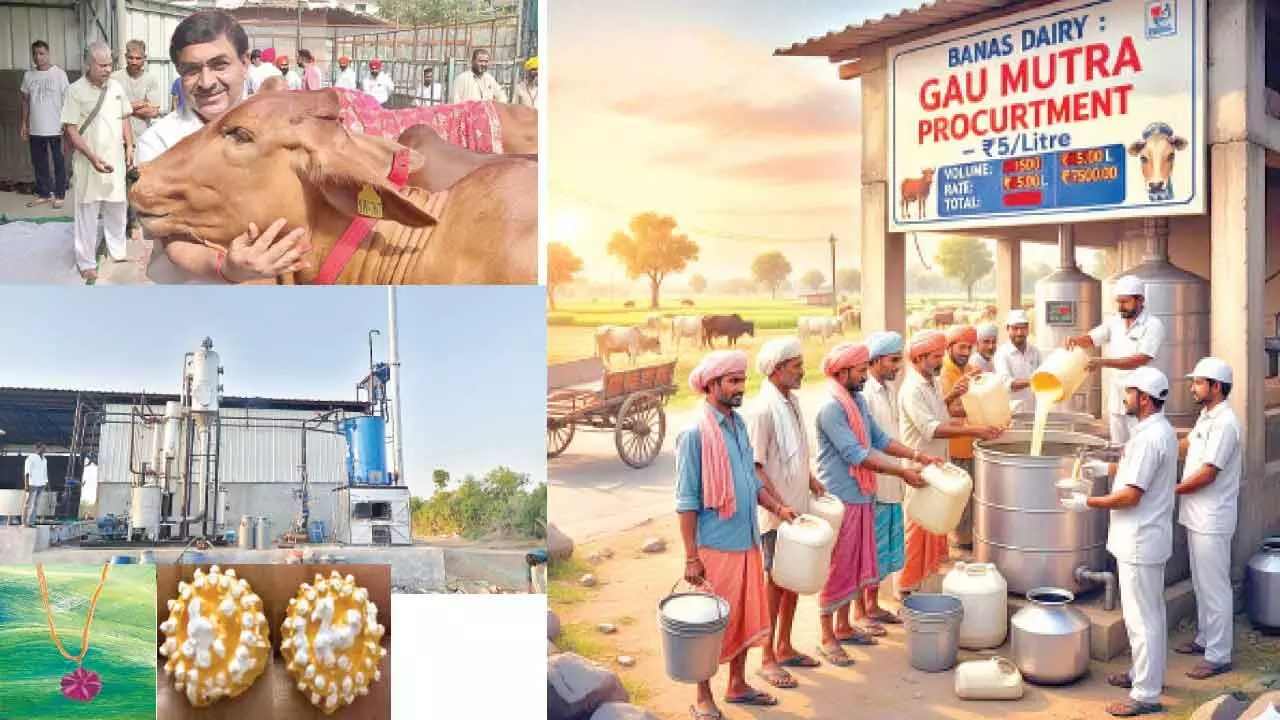
Gujarat has emerged as a model in this movement. In Banaskantha district, the world’s first Gaumutra Dairy purchases about 1,000 litres of cow urine daily from farmers, providing an important supplementary income source while encouraging the rearing of indigenous cattle and organic farming. The unit produces biological liquid fertilisers, pest repellents, and organic manure from cow urine that would otherwise go to waste.
Efforts are underway to scale production to 10,000 litres in the next six months, says Agrivet Shyam Sundar, who owns the unit. The model creates a virtuous cycle—farmers earn more by selling cow urine, buy organic fertilisers, obtain healthier yields, and build long-term soil fertility. In short, the cow becomes an economic partner again, not a burden abandoned once milk production declines.
Gujarat is also pioneering innovation in renewable energy through bull-powered electricity generation. Using treadmill-based systems, the kinetic energy generated as bulls walk is converted into electricity—each bull capable of producing up to 4 kilowatts of power, sufficient for rural households and agricultural operations. This approach preserves the male bovine population, supports natural breeding, and reduces dependence on artificial insemination—all while generating clean energy.
Turning Dung Into Development
India produces lakhs of tonnes of cow dung daily—an untapped resource with potential to power the rural economy. By converting this material into useful resources—biogas, CBG, organic fertiliser, and consumer products—we can reduce imports, revive villages, and strengthen ecological balance.
According to Dr. VallabhaiKathria, renowned surgeon, former MP from Rajkot and founder of the Global Confederation of Cow-Based Industries, India must “reinvent the wheel” by reviving traditional knowledge and freeing the country from the harmful influence of excessive western-style chemical farming that has destroyed soil and health. Speaking to this author, Dr. Vallabhai emphasised his mission to unite cow-based industry stakeholders under one umbrella to transform the Brown Revolution into a nationwide movement.
The challenge, he says, lies in building effective cooperative structures—an area where India has only a few shining examples like Amul. Yet, interest from organisations in Rajasthan, Andhra Pradesh, Delhi, and Karnataka signals that momentum is building. Once farmers and gaushalas realise the economic value of cow-based products, no cow will ever be abandoned or sent to slaughter, because dung and urine itself provide continuous value.
Innovation: From Paint to Jewellery
Cow dung is today emerging as a raw material for industries one would never imagine. Prakritik Paint or Gobar Paint—an eco-friendly, antibacterial, antifungal, non-toxic paint—has been developed using cow dung and natural binders. It purifies air, protects walls, and replaces chemical-based paints. The age-old tradition of coating mud walls with cow dung has returned in a modern, scientific avatar.
Cow dung is also being used to create handcrafted jewellery—earrings, pendants, bracelets, studs—under the brand PanchAura, promoted by the Delhi-based NGO Bharat Ekam. Toxin-free, biodegradable, spiritually symbolic, and affordable, it blends sustainability with culture.
In Karnataka, GoPals is driving similar transformation across Karnataka, Andhra Pradesh, and Telangana. All these initiatives show a new India rising—where innovation meets tradition, and sustainability meets enterprise.
The Road Ahead: Policy Support and Public Awareness
For the Brown Revolution to succeed, stronger support from state governments and proactive hand-holding is essential. Agriculture and information departments must be involved in spreading awareness and training at the grassroots. Startups in cow-based industries, biogas, and organic fertiliser manufacturing must receive funding, incubation, and market access.
This movement is gaining serious traction. To accelerate it, Swadeshi Jagaran Manch and GCCI are organising Bharat’s biggest four-day Swadeshi Expo in Ahmedabad from December 4, showcasing innovations and business opportunities in cow-based industries and natural farming.
Conclusion: A Call for National Awakening
India stands at a historic crossroads. The White Revolution proved we can transform rural economies when we mobilise collective will. The Brown Revolution now calls upon us to restore the sanctity of soil, revive indigenous strength, empower farmers, and create a healthier and greener nation.
This is not merely an agricultural shift—it is a civilisational mission.
A mission to honour the cow.
A mission to heal the earth.
A mission to rebuild rural pride.
A mission to ensure prosperity for future generations.
The soil holds the destiny of 140 crore Indians. It is time to rise, to unite, and to build the Brown Revolution—India’s next great leap forward.


